They say the geek shall inherit the Earth. I’m counting on it.

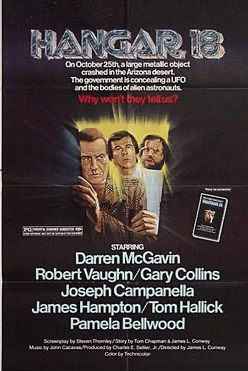
  • Hangar 18 is a 1980 sci-fi film directed by James L. Conway.

    The story sees a 3-man crew aboard the space shuttle about to launch a satellite. Whilst doing so, they witness an apparent UFO moving at great speed, which ends up colliding with the satellite. The resulting explosion kills one astronaut and when the two survivors, Steve and Lew, return to Earth, they find themselves blamed for their colleague’s death.

    Conspiracy and coverups ensue as the astronauts find themselves stonewalled and eventually in serious danger from the powers-that-be.

    At the same time, it turns out the alien ship has crash landed on Earth and is taken to the mysterious Hangar 18, where a team of NASA boffins – led by NASA’s deputy director Harry Forbes – study the mysterious craft and make some startling deductions.
    If it sounds as though there’s a lot going on, well, you would be correct, there is, but I am pleased to say that all in all, Hangar 18 is a fun film. It is an interesting UFO / conspiracy thriller and I think it works rather well.

    The film has a couple of nice set-pieces, such as when the scientists watch as the craft opens up for the first time. There is a real sense of anticipation as to what they might find. Also, despite not being particularly frightening, it has a lovely little jump-scare when the scientists find an unconscious woman in the alien ship. She is taken away in an ambulance and, completely out of the blue, she sits up and starts screaming. It is a moment which is highly unexpected and cleverly filmed.

    The story basically has two strands. The first sees the two surviving astronauts trying to find the truth behind their dead colleague, and the second is the scientists investigating the alien ship. You would think the scientist scenes would slow the pace down but I think they are done nicely and they also come up with some interesting revelations. (Eventually the boffins deduce that the aliens have been to Earth before and the humans are their descendants. Think Quatermass and the Pit).

    The acting in Hangar 18 is strong. Gary Collins and James Hampton are good as Steve and Lew, the frustrated astronauts determined to get to the bottom of their colleague’s death. And the fab Darren McGavin plays Harry, the NASA deputy director who threatens to go to the media unless the truth is revealed.

    The finale is nicely done as we see just how far the powers-that-be are willing to go in order to protect their secrets. Unfortunately for them, things do not go quite to plan and, as the credits rolled, I would really like to have seen more.

    Hangar 18 is a smart, fun film, a cut above some of the nonsense of this era, and it is well worth a watch.
    Fediverse Reactions
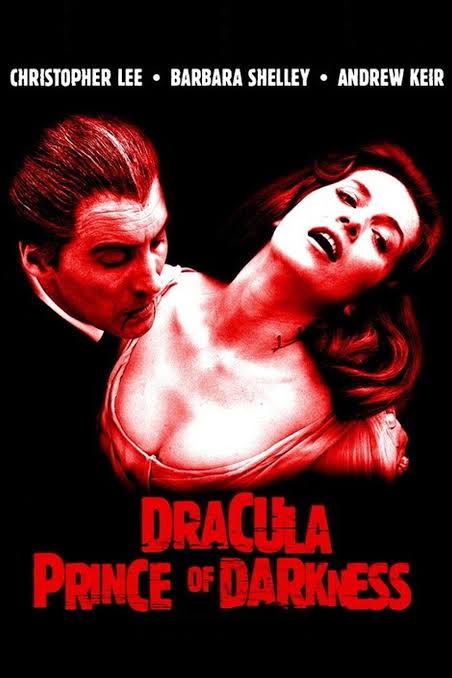
  • Dracula:Prince of Darkness is a 1966 gothic horror film directed by Terence Fisher. It is the third entry in Hammer’s Dracula series, and the second to feature Christopher Lee as the count.

    The film starts with a brief recap of the finale of 1958’s Dracula, which sees Peter Cushing in full action hero mode as Van Helsing.

    We then skip forward in time. 10 years have passed since the events of Dracula, but the local people still live in fear of vampirism. Father Sandor (the fab Andrew Keir) prevents a recently deceased young woman from being staked through the heart by a group of frightened locals. He calls them barbarians and insists that the girl be buried properly in a churchyard. This all has interesting parallels to the hysteria of witchcraft which peaked in Europe between the 15th and 18th centuries.

    Into the mix come four English tourists who, of course, ignore warnings not to visit the nearby Karlsbad. They travel by horse and coach, but are quickly abandoned by their frightened coach driver in the shadow of a mysterious castle. The driver ominously warns them that if any of them are still there in the morning, he will return and take them to Karlsbad.

    After being abandoned, another coach suddenly appears – pulled by horses but with no driver. And what do they do? Get into it of course. I mean, really, who thought that was a good idea? I don’t know about you, but I would be running as fast as possible in the opposite direction.

    Only Barbara Shelley’s Helen voices any objection. She is clearly afraid but the others treat her almost as a figure of fun. If only they had listened to her warning.

    “There’ll be no morning for us.”

    The moral of this story is that Barbara Shelley should always be listened to.

    Anyway, the intrepid visitors reach the castle and quickly discover that four places have been set for dinner (creepy). Also, they find their luggage has been laid out in their rooms (very creepy).

    And then the fun really starts, with Helen’s husband Alan being literally stabbed in the back and, in one of the film’s most shocking scenes, strung up and having this throat cut, so that his blood might revive Dracula himself.

    Suddenly, the count is back and his focus is firmly on the prim and proper Helen. Before our eyes, she changes from this frightened, quiet wife to someone who can only be described as sex on legs. This is entirely down to Barbara Shelley who is just so damn good.

    There are a few very effective moments in the film, none more so than when Dracula is being revived and, through the smoke rising from the crypt, his hand suddenly emerges. Very nicely done!

    Another memorable moment is when Charles (Francis Matthews in super suave mode) discovers Alan’s body. We do not see anything but the reaction on Charles’ face tells us everything we need to know.

    Another moment to mention is when Dracula rips open his shirt, cuts his chest and pulls Suzan Farmer’s Diana towards him, for her to drink his blood. I mean let’s be honest, ladies, we’ve all had dates like that, haven’t we?

    The acting here is all very good. Barbara Shelley is definitely MVP as Helen. The change in her demeanour is remarkable. And Andrew Keir, in what is basically the Van Helsing role, is terrific as Father Sandor.

    Also, special mention to Phillip Latham as Klove, Dracula’s servant. Early on, Helen describes him as, “Terrifying,” and I am with her 100%.

    Overall, I do think Dracula:Prince of Darkness is one of the better Dracula films. It’s nothing we haven’t seen before, but still very entertaining nonetheless.

    Fediverse Reactions
  • Star Cops was a British sci-fi TV series, first broadcast on the BBC in the summer of 1987. It was devised by Chris Boucher, who had previously worked on TV shows such as Blake’s 7 and Dr. Who.

    Set in 2027, the show followed the International Space Police Force – the Star Cops – as they provided law enforcement to the new colonies developing through the solar system. The force was led by Commander Nathan Spring (the fab David Calder), who, along with his team, faced crimes ranging from murder, terrorism and drug smuggling, all in the most unhospitable of surroundings.

    Along for the ride was David Theroux, Nathan’s American second-in-command, who was so dull I would regularly forget about him. His character did not appear in the final episode due to the actor being ill, and sadly I do not think he was missed.

    Much more interesting was the five-times married Inspector Colin Devis, played rather brilliantly by Trevor Cooper. Although rather obnoxious, he actually turned into an incredibly likeable and, most importantly, fun character!

    And finally we have the wonderful Pal Kenzy, played by Linda Newton. An Aussie firebrand, Kenzy started off very much out for herself, but by the end of the series she had shown herself to be loyal and faithful to her colleagues. She was my absolute favourite. Watching the show back in 1987, the 14-year-old me had no idea women could be like that. She was my hero!

    From the start, Star Cops was plagued by behind-the-scenes tension between its creator and producer. The main problem, however, was that it was stuck away on BBC2 in July, almost as if the BBC wanted it to fail. Broadcast times varied between 8:30pm and 9:55pm, as it found itself up against the ratings juggernaut that was Terry and June (yes, really!) It is such a shame because it really was a decent, ‘proper’ sci-fi show. When rewatching it years later, I found it to be way more grown up than the teenage me had remembered.

    Star Cops lives on in audio form with a range of audio plays from Big Finish, and David Calder, Trevor Cooper and Linda Newton all reprising their roles as Spring, Devis and Kenzy.

    In my opinion it’s a bit of an overlooked gem, with these nine episodes being the perfect example of what might have been.

    Fediverse Reactions
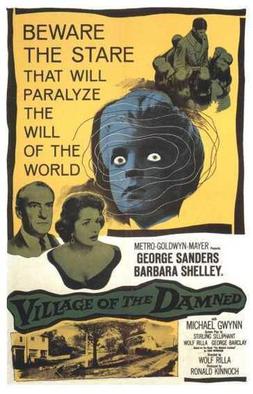
  • Village of the Damned is a 1960 sci-fi horror film, based on The Midwich Cuckoos by John Wyndham.

    In the quiet village of Midwich the entire population falls unconscious for a period of a few hours. There is complete silence apart from the eerie ringing of the church bells. It is quite a startling beginning and immediately we know something strange is at work.

    The military establishes a cordon around Midwich and eventually everybody regains consciousness, apparently unharmed by the bizarre incident.

    But – and it is a big but – two months later, all the women and girls of child-bearing age are discovered to be pregnant. And, to make things extra creepy, they all fell pregnant on the same day as the mysterious ‘time out’.

    When the women start to give birth, we find the babies all weigh roughly the same and have, in the words of the local doctor, “Strange eyes.”

    Village of the Damned is an absolutely cracking horror movie which really stands the test of time. The whole premise of the plot is extremely eerie, with a “What if?” kind of vibe. What would you do in that situation?

    The men of the village are left angry and powerless. In fact one of the most intense moments occurs in the pub when the men all sit quietly, either drinking or playing darts. They are almost shell-shocked at what has happened.

    The film has a quite wonderful cast, headed by George Sanders who is fabulous as Gordon Zellaby, commanding and frustrated in equal measure. And incredibly brave, as his actions at the finale show. And the brilliant Barbara Shelley provides great support as his loving wife, Anthea. There is such an interesting moment when Anthea tells Gordon she is pregnant. We contrast their delight with another villager who finds out she is pregnant when her husband has been away at sea. It is incredibly well done.

    The children are quite terrifying, with their glowing eyes and monotone way of talking. And they are powerful, which we see clearly on a couple of occasions, when they hypnotise a man into shooting himself with a rifle, and hypnotise another into setting himself on fire.

    The fact that this is set in a nondescript village makes it all the more frightening. If it can happen here, it can happen anywhere.

    Village of the Damned is a proper classic which still packs a punch 60 years later.

    Fediverse Reactions
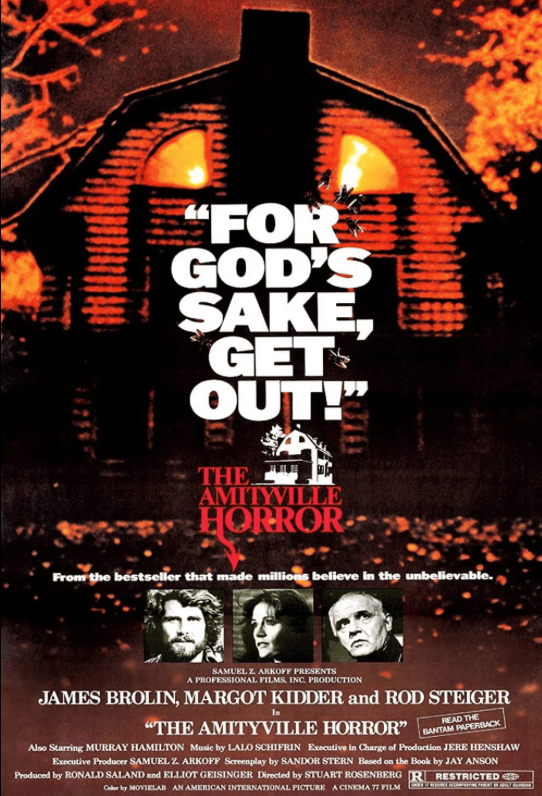
  • The Amityville Horror is a 1979 supernatural horror film directed by Stuart Rosenberg. It is based on Jay Anson’s 1977 book of the same name, and tells the story of the Lutz family who move into a house in Amityville which, two years earlier, was the scene of mass murder, when Ronald DeFeo Jr. slaughtered his entire family.

    Very quickly, the family begin to experience strange goings-on, so much so that within a month of moving in they end up fleeing the house in fear and leaving all their belongings behind.

    There is quite an effective moment early on, when George and Kathy are being shown around the house, and the scenes of them moving from room to room are interspersed with very brief clips of the murders being committed. We know something awful has happened but we do not really know the full extent.

    Rod Steiger’s Father Delaney – a family friend – comes to bless the house, and here we get the first glimpse of the strange powers which are at work. The fly infestation, the mysterious voice (“Get out!”), are only the beginning, and the Lutzs soon realise they are not alone.

    Events affect George in particular and he displays evidence of being possessed. James Brolin is very good as the troubled George, and his descent into madness is very well done.

    Margot Kidder is also good as Kathy, desperately trying to hold her family together in the most trying of circumstances.

    My problems with this film is, well, it’s just boring. Don’t get me wrong, there are a couple of good bits (the glowing eyes at the window, the slime oozing from the walls). But I just find so much of it underwhelming that I am genuinely surprised it is held in such high regard.

    Not a fan, sadly.

    Fediverse Reactions
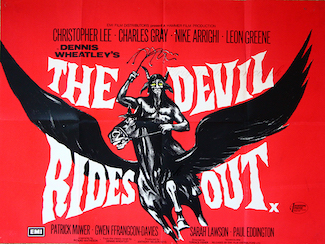
  • The Devil Rides Out is a 1968 British horror film starring Christopher Lee. It is written by Richard Matheson, based on the novel by Dennis Wheatley, and directed by Terence Fisher.

    Christopher Lee – in a rare ‘good guy’ role – plays Nicholas, the Duke de Richleau – who, along with his friend Rex, tries to rescue young Simon, the son of a late friend of his, who is somehow mixed up with black magic. Cue secret societies, devil worshipping, goat sacrifice, and an appearance from The Angel of Death.

    But this is all in a day’s work for Lee’s dashing Duke. We are used to seeing him with fangs and a swishy cloak, but here he is so good as the heroic Nicholas, ably supported by Leon Green’s Rex (who had his voice dubbed by the unmistakable Patrick Allen. Why? Who knows).

    Patrick Mower is also very good as the young wide-eyed, slightly naive Simon, whilst Charles Gray is frightening as the evil Mocata. The close-ups of his piercing blue eyes sent a chill down my spine.

    It is interesting that The Devil Rides Out is much more serious than the usual Hammer fare of this period. There is very little violence or blood, and it does not have the usual slightly camp feel which Hammer films often had.

    That is not to say there aren’t moments which are quite shocking. Mocata’s night of black magic is very well done, with the Duke and his friends seeking sanctuary inside a pentagram on the floor, and experiencing everything from mysterious voices and strange winds to giant spiders.

    The film has a clear theme of good overcoming evil. It is not subtle but it is still very well done.

    I am not familiar with Dennis Wheatley’s original novel so I do not know how the film compares, but The Devil Rides Out is a huge amount of fun and well worth 90 minutes or so of anyone’s time.

    Fediverse Reactions
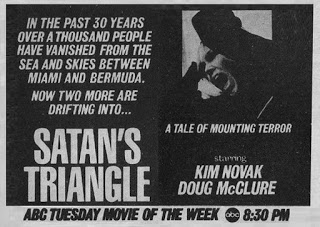
  • Satan’s Triangle is a 1975 made-for-TV horror, directed by Sutton Roley.

    The story revolves around a U.S. Coast Guard helicopter being sent to answer a distress signal emanating from inside the Bermuda Triangle.

    The helicopter finds an apparently abandoned vessel, so Haig, the helicopter winch man, (played by the legend that is Doug McClure) is lowered onto the vessel to investigate. He finds a sole survivor called Eva, and due to a twist of fate, the pair must spend the night alone onboard the abandoned vessel.

    During this time, Eva tells her tale of a fishing trip gone badly wrong and a creepy priest they pick up adrift at sea who is definitely up to no good. Just to emphasise this fact, there are lots of crashes of thunder and lightning and the priest tells a tale about the Devil’s Triangle. (I told you he was creepy).

    Once Eva tells her story she and Haig have the obligatory shag and that really is about it.

    Or is it?

    I wish I had positive things to say about Satan’s Triangle but unfortunately it commits the cardinal sin of being boring. I would much rather watch a film which was terrible but at least provoked some emotions, than something which is more limp than a wet lettuce.

    However, there are a couple of nice moments, such as when Haig first discovers the body hanging from the mast. This is quite well done. Also, later on he finds another body apparently floating in mid air. Again, this is well done and actually rather disturbing.

    There is also a neat moment at the end when Haig appears to have been possessed and the film ends on him with a rather evil grin on his face. But my goodness, it doesn’t half take its time to get there.

    I love a bit of Bermuda Triangle action – the 1970s was full of these kinds of stories – but sad to say that Satan’s Triangle is an utter snooze fest of the highest order.

    Fediverse Reactions
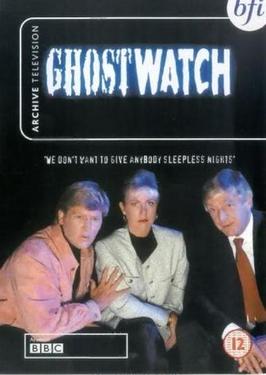
  • Ghostwatch was a British supernatural mockumentary first broadcast on BBC 1 on Halloween night of 1992.

    Presented as live – although actually part of the BBC’s Screen One anthology drama series – the show aimed to provide definitive proof of the paranormal. It was hosted by TV stalwart Michael Parkinson, a very familiar face to British viewers, and saw a fictitious investigation into supposed ghostly goings-on in a house in North London.

    The investigation was anchored by Sarah Greene – another well-known face on British TV – along with her husband, broadcaster Mike Smith, and Red Dwarf actor Craig Charles.

    The whole idea of the haunted house is clearly based on the famous Enfield Poltergeist case of the 1970s and in the Ghostwatch version we have a mother and her two daughters being terrorised by some unseen force, referred to as “Pipes”.

    At first everything seems fine, but gradually things starts to escalate until we reach the film’s shocking conclusion.

    The impact of Ghostwatch cannot be understated. It has never been shown again on UK TV and caused numerous complaints to the Broadcasting Standards Commission about how it left children traumatised. Using Sarah Greene – a very familiar face on children’s TV – perhaps led parents to believe the show would be suitable for their kids.

    How wrong they were.

    Having these familiar faces was a masterstroke, especially Michael Parkinson, who was host of a long-running chat show on the BBC, and one of TV’s most familiar faces. Also, this was the BBC and we (at the time of broadcast at least) trusted them. They would not try and fool the viewer in this way, would they?

    Watching Ghostwatch all these years later, it maybe looks a bit silly and unbelievable. Ghost hunting TV shows are so common these days, but 30 years ago there was no such thing. The last 10 / 15 minutes or so are genuinely creepy, and it is easy to see how a generation of children were scared witless.

    This is a highly original piece of work and it is such a shame that the controversy over Ghostwatch is more remembered than the actual drama itself.

    Fediverse Reactions
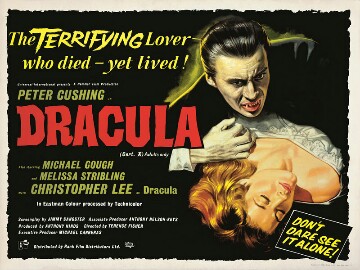
  • Dracula is a 1958 Gothic horror from Hammer, directed by Terence Fisher.

    Not only was it the first Hammer film to star Christopher Lee, but it was also the first vampire movie shot in colour.

    The story sees Jonathan Harker arrive at Dracula’s castle on the pretext of being the new librarian. Very quickly, we realise that Harker is in fact a vampire hunter and has Dracula in his sights.

    After Harker disappears, his friend, Dr. Van Helsing – played by the legend that is Peter Cushing – comes looking for him…..and then the fun really begins.

    It is hard to imagine the impact Dracula must have had on audiences back in 1958. From the opening titles with the splattering of blood, it is clear that this is something a bit different.

    It looks incredible, with its vibrant colours and healthy dose of blood and gore (at least compared to what audiences of the time were used to). And it is sexy, and I mean super sexy.

    Christopher Lee does not say much, but his first appearance at the top of the stairs is very dramatic. And his female victims look as though they might just be enjoying the attentions of the sexy count and his swishy cloak – all very daring for the time!

    There are a couple of nice emotional moments during the course of the film, which are very well done. When Harker realises he has been bitten and what fate awaits him, as he bravely writes his final diary entry. And when Van Helsing discover’s Harker’s lifeless body in the crypt and does what he has to do in order to free his friend from his curse.

    Christopher Lee is just do damn brilliant in this. He is so imposing and yet seems to almost glide everywhere. Frankly, he is terrifying.

    And Peter Cushing is just wonderful as the heroic Van Helsing, who turns into a proper action hero at the finale, when he forces the count into the sunlight and watches him disintegrate into dust.

    Dracula is such an important film, one which changed the image of vampires in popular culture. All these years later, it is still essential viewing.

    Fediverse Reactions
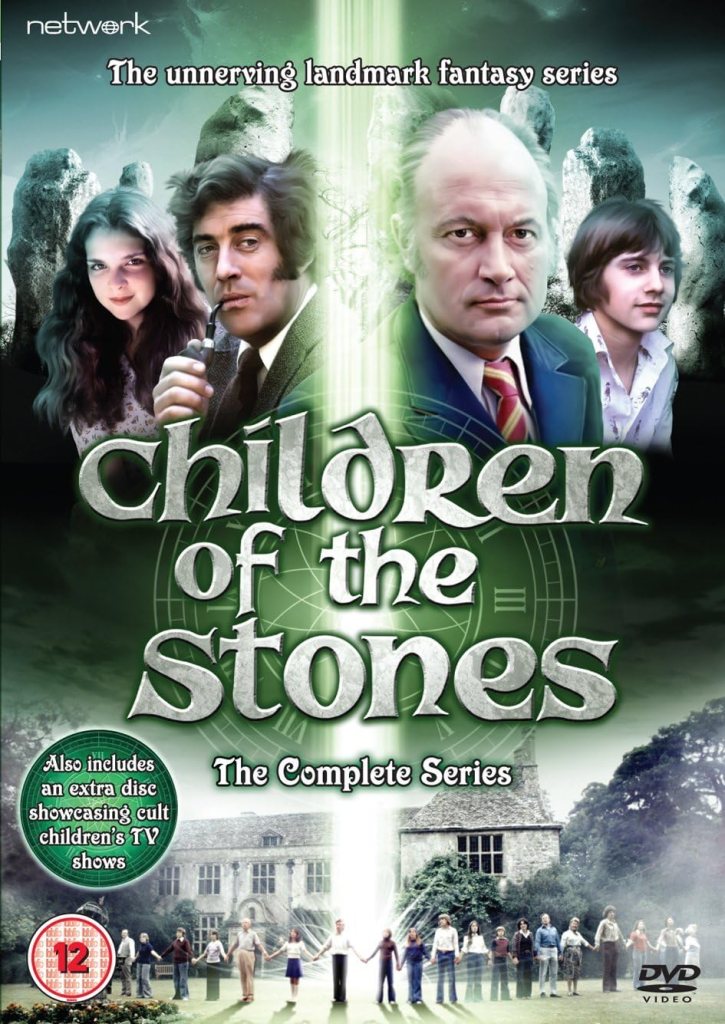
  • Children of the Stones is a seven-part British children’s drama, first broadcast on ITV in 1977.

    It tells the story of scientist Adam Brake (a pre-Blakes 7 Gareth Thomas), and his son Matthew, who arrive in the sleepy village of Milbury which is surrounded by a mysterious neolithic stone circle.

    Very quickly, they find that everything is not as it seems. The stones emanate a mysterious power which seems to hold the villagers captive, brainwashing them into perpetually (to almost quote REM), happy, smiling people who greet everybody with the same refrain.

    “Happy day!”

    As events spiral out of control, Adam and his son must face occurrences which challenge their beliefs about the very nature of time itself.

    It is difficult to know where to begin when trying to describe Children of the Stones. This is a truly exceptional drama and quite astounding that it was made specifically for children’s TV.

    It is genuinely disturbing in parts, from the opening titles, which are deeply creepy, to the incidental music, which is like nothing I have ever heard before. The weird choral chanting is repeated again and again and, in truly terrifying scenes, we see the possessed villagers all gather together, join hands, and sing this weird, haunting hymn, as though it is the most natural thing in the world for them to be doing.

    Amongst the chaos we have Gareth Thomas who is utterly convincing as scientist Adam, having his beliefs challenged more and more as the series progresses. Peter Demin is also very good as his son, Matthew. In fact, all the child acting in the show is of a particularly high standard.

    Iain Cuthbertson is wonderful as the sinister Hendrick, who seems to be the instigator of all the strange goings-on.

    Children of the Stones is pure folk horror, part The Wicker Man and part Village of the Damned. How it was thought to be suitable for children’s TV is anybody’s guess, but I am so glad it was.

    Don’t you just love the ’70s?!

    Fediverse Reactions