They say the geek shall inherit the Earth. I’m counting on it.

  • The Unfolding is a 2016 horror film, written and directed by Eugene McGing

    With the world teetering on the brink of nuclear war, paranormal researcher Tam and his girlfriend Rose travel through the English countryside to investigate supposed ghostly goings-on in an old country house. On arrival, they are greeted by the current occupier who is packing up to leave, having been driven from the home by unexplained events.

    Tam and Rose decide to stay and, after a quiet start, things begin to escalate. They are joined by Tam’s friend Harvey, and eventually Professor Chessman and Muriel, a psychic, as they try and unlock the house’s terrible secrets.
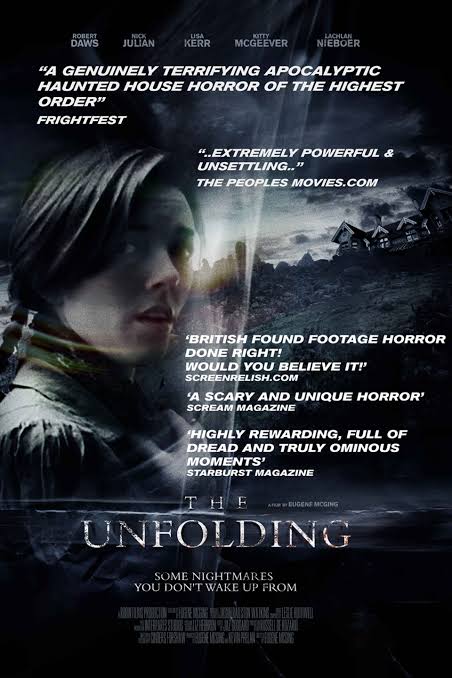
    First things first. The Unfolding is clearly a very low-budget film. The audio is a bit unclear at times, although that could be down to the creative use of camcorders and security cameras, as well as traditional cameras for filming. It is sort of a found footage film but not exactly.

    On the positive side, it really has a wonderful atmosphere. The washed out colours give it a real downbeat vibe, and the incidental music is very evocative.

    After a slowish start there are a few creepy moments. Doors creak open, shadows appear on camera, and disembodied screams fill the house in the dead of night.

    At one point, Tam and Rose’s bedroom door is battered from the outside, as he valiantly tries to hold it shut. It is very reminiscent of a scene in The Haunting (my all-time favourite haunted house film).

    Acting wise, everybody plays their part well. Robert Daws would be the most recognisable face and he is very believable as the professor. Lachlan Niebor is also convincing as the increasingly obsessive Tam.

    Yes, it is low budget, and no, it won’t change the world in terms of horror films, but I would much rather watch a film like this than yet another entry into the insufferable Paranormal Activity series.

    Definitely worth a look.
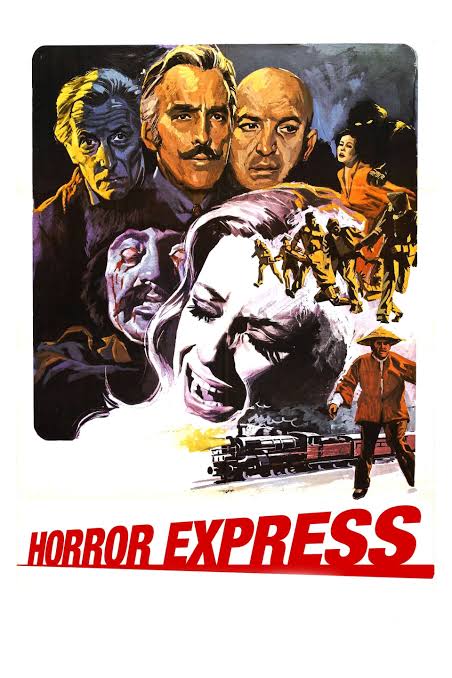
  • Horror Express is a 1972 sci-fi horror film directed by Eugenio Martín and starring horror legends Peter Cushing and Christopher Lee.

    Set in 1906, we meet Lee’s Alexander Saxton, an eminent anthropologist, returning to Europe via the Trans-Siberian Railway with the frozen remains of a humanoid discovered on one of his expeditions – potentially the Missing Link.

    Cushing is Dr. Wells, Saxton’s friendly rival, who is determined to discover what exactly the famous anthropologist is transporting in a mysterious crate. Before long, passengers and crew are being stalked by a mysterious alien creature which has the ability to inhabit the bodies of its human victims.

    Throw in a random Polish count and countess, a monk who acts as their spiritual adviser, and a bunch of terrified passengers, and the scene is set for a fun 90 minutes.

    And if that wasn’t enough, Telly Savalas turns up near the end as a Cossack captain.

    Films set on board trains always have a nice sense of claustrophobia and atmosphere, and this one is no exception.

    Christopher Lee and Peter Cushing have never been better as the bickering rivals, so much so that it is my favourite Lee / Cushing movie.

    The makeup and effects work well. The white eyeballs and blood streaks on the face of the victims is nicely done. Talking of eyeballs, there are a few suitably bloody moments – say no more!

    It is not particularly frightening although there is a moment near the end when the dead all begin to rise up, zombie like, and I found that moment particularly chilling and highly effective.

    This is such a fun film which I could watch again and again.

    Highly recommended!

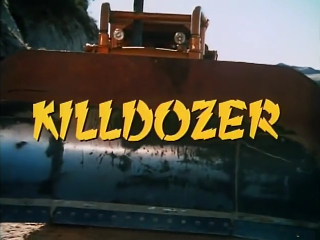
  • Killdozer is a 1974 made-for-TV sci-fi / horror film, directed by Jerry London. It was adapted from Theodore Sturgeon’s 1944 novella of the same name.

    A meteorite crash lands on a remote island off the coast of Africa. It contains an alien entity which takes over a large bulldozer and goes on a killing spree.

    Just in case you think you may have misread that, let me reiterate. An alien entity takes over a bulldozer and goes on a killing spree.

    We start off with a bunch of construction workers who discover the mysterious meteorite. One worker gets a bit too close, is badly injured, and dies soon after. (Robert Urich, who has the good sense to get himself killed off quickly).

    There then follows a series of set-pieces where the pesky, possessed digger handily destroys the workers’ radio, their entire camp, and, in one unintentionally hilarious moment, it chases (I mean, lumbers) after a worker into bushland before crushing him to death.

    All the while, the other men stand around looking very serious, and not one bothers asking, “What the actual **** is going on here?”

    Obviously, being a made-for-TV movie, there is no blood, but, to be fair, there is absolutely no tension, humour, excitement or interesting characters. It’s just sort of, meh, dull, bland, it starts and then it finishes. I do wonder who on earth thought this was a good idea.

    Acting wise, Clint Walker is fine as the square-jawed hero, although there is a bizarre moment when he stands in front of the bulldozer shouting, “Come and get me!”

    I mean, we’ve all had days like that, haven’t we?

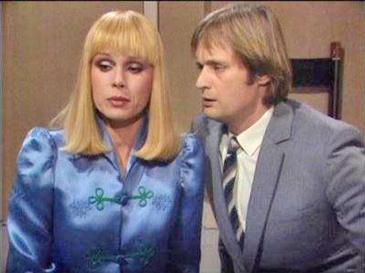
  • Sapphire and Steel was a British supernatural / fantasy TV series which was broadcast on ITV between 1979 and 1982.

    There were 34 episodes in total, divided into six separate stories, or “Assignments”.

    The focus of the programme was on Sapphire (played by Joanna Lumley), and Steel (played by David McCallum), a pair of ‘operatives’ whose job it was to guard time. This explanation may sound a little vague but it keeps in with the whole vibe of the show. Sapphire and Steel was utterly baffling at the best of times, and tended to leave more questions than answers. It was also eerie, atmospheric and highly original.

    I watched this between the ages of six and nine, didn’t really understand what was going on, but was hooked all the same.

    Our heroes were also assisted by other characters, including Lead, and most notably Silver (played by the fabulous David Collings).

    If you speak to anyone who is a fan of the show, inevitably they will talk about the ‘haunted railway station’ episode – Assignment 2.

    A parapsychologist – the quite wonderful Gerald James – investigates ghostly sighings at an abandoned railway station, and the scene is set for an extremely creepy tale involving dead soldiers, airmen, and a quite horrifying conclusion, as Steel shows his cold side. (Steel by name, Steel by nature).

    Yes, it is slow-moving, but the atmosphere is off the scale and it leaves us with a few disturbing moments. Apart from the finale of Assignment 2, the story of the faceless man and the lost girl in the photograph is difficult to forget (if you know, you know).

    Both Lumley and McCallum are utterly believable in their roles. I really did think that Sapphire could ‘take back time’. The series ended on a frustrating cliff-hanger and it seems as though there were no clear plans for a new series.

    Sapphire and Steel is the type of show which, sadly, we are unlikely to see again. I do not think modern audiences would commit to watching such a slow-moving, talky drama, which is a shame, because this is a superior piece of work and stands out as one of the most original dramas of the last 50 years or so.

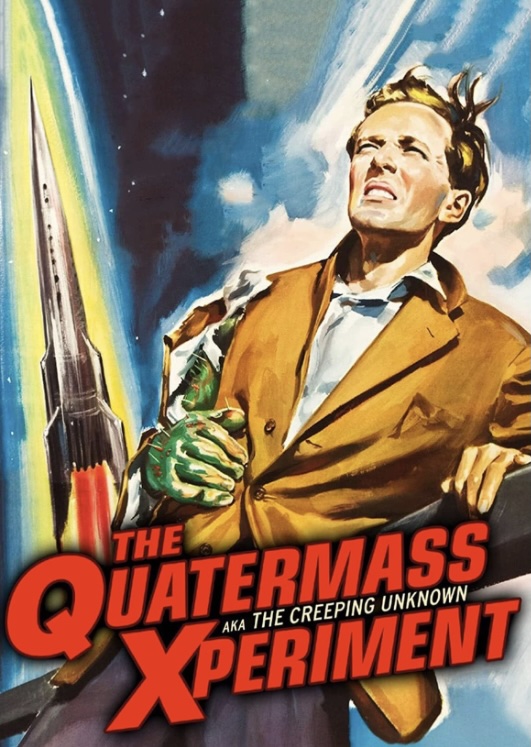
  • The Quatermass Xperiment is a 1955 Hammer film directed by Val Guest. It was based on the 1953 BBC serial of the same name.

    Three astronauts are sent into space in a rocket designed by Professor Quatermass. The rocket crash lands back on Earth, and only one astronaut – the unfortunate Victor Carroon – is still on board. Very quickly he begins mutating into an alien creature.

    As the authorities try to discover exactly what happened, the doomed Carroon escapes and it is left to Quatermass and Inspector Lomax to try and track him down.

    The Quatermass Xperiment was a huge success, and I can understand why. It taps into the 1950s post-war paranoia, atomic bombs and the like. Should we be messing with things we do not understand?

    Also, the make up on Victor Carroon is quite incredible. Even early on in the film he almost looks like a walking corpse. In fact, there is something quite Frankenstein’s monster about him after he escapes from the hospital. His lumbering, shambolic, confused demeanour is actually quite heartbreaking.

    There are a couple of memorable scenes, such as the horrific moment Quatermass and co watch the recovered footage of what exactly happened inside the doomed capsule. Also, the scene at the zoo when Carroon is nearby. The animals just know something is wrong.

    The casting is okay. Brian Donlevy is fine as Quatermass, but not terribly likeable, whilst the likes of Jack Warner and Lionel Jefferies offer good support.

    But this is Richard Wordsworth’s film as the tragic Carroon, and it is his performance which stays long in the memory

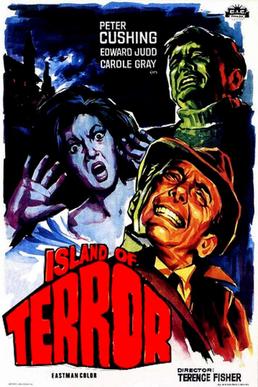
  • Island of Terror is a 1967 horror film from Planet Film Productions, directed by Terence Fisher.

    On yet another remote island, scientists are doing covert experiments to try and discover a cure for cancer. But, as we all know, the road to hell is paved with good intentions and the scientists end up creating mysterious creatures – dubbed Silicates – who kill their victims by injecting a bone-dissolving enzyme into their bodies.

    Before anyone can say, “Ouch, that’s got to hurt,” enter our heroes, Drs. Brian Stanley and David West (and not forgetting West’s useless girlfriend, Toni), who must try to decipher exactly what is going on, and more importantly, can the Silicates be stopped.

    Meanwhile, islanders are being bumped off left, right and centre, and their death scenes are accompanied by a rather gruesome, slurping sound, something similar to a child sucking their milkshake too loudly through a straw.

    The unfortunate victims are left as a blob of flesh and nothing else, which might look a bit silly but I think is quite effectively done.

    Peter Cushing is as believable as ever as Dr. Stanley. To be honest, Cushing could tell me the sky was pink and the moon was made out of cheese and I would believe him.

    Edward Judd is okay as Dr. West, but I find him a bit irritating. I am not sure if it is the way the character is written or the actor himself (there are plenty of stories out there about him having an inflated ego), but his manner here just annoys me.

    There is also good support from Eddie Byrne and Niall MacGinnis (of Night of the Demon fame). Admittedly, Carole Gray has a thankless task as West’s girlfriend, Toni Merrill, but my goodness, she is annoying. Apart from commandeering her father’s helicopter to fly them to the island, she serves no purpose except to scream and tell everyone how frightened she is.

    I know this was the way female characters were treated back then but it is just so tiresome.

    To be fair, the film is nothing special and we have seen it all before, but there are a few nice atmospheric moments. We can easily guess who is going to live and who is going to die, but it is all good, silly fun nonetheless.

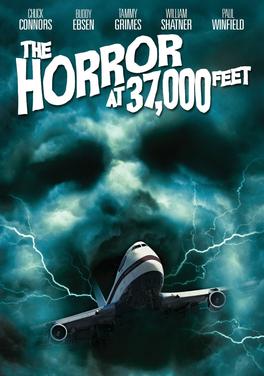
  • The Horror at 37,000 Feet is a 1973 supernatural / horror TV movie starring Chuck Connors and William Shatner.

    The plot revolves around a flight between London and New York which is carrying an altar stone from an old English abbey. Before long, the passengers and crew are faced with strange demonic forces emanating from the baggage hold.

    A bit like flying easyJet.

    It turns out that the altar stone is haunted by druids who are unhappy at being uprooted from their home. In fact, they are not just unhappy, they are totally pissed. The only way to placate them is by offering a human sacrifice.

    Definitely like flying easyJet.

    But fear not, help is at hand in the shape of William Shatner’s drunk ex-priest, Kovalik, which is handy because when a passenger begins reciting Latin, he is able to translate that she is actually quoting a black mass.

    Absolutely like flying…okay, yes, you get the picture.

    I remember seeing this film when I was a kid and being absolutely terrified by it. But let’s not beat about the bush here, it is awful. It is typical 1970s fare, with the usual rag-tag assortment of actors and characters we would see in any disaster movie of this era.

    And talking of the cast, they all take it very seriously, and I am not sure if that is a help or a hindrance. Chuck Connors is in tough guy mode as the captain whilst Paul Winfield adds a touch of class as a passenger who, handily, is a doctor.

    And then we have William Shatner, never the most convincing of actors, as the ex-priest, spouting endless profound comments about the futility of faith. And yet, he is the one who steps up bravely and pays the ultimate price.

    Also, there is such a clever moment when, towards the end, Kovalik is walking down the plane, flaming torch in hand, in order to confront the ‘enemy’. For a brief moment we see him in his priest garb, as though he has suddenly regained his faith, before the next scene he is back in civilian clothes. It is such a neat touch and quite unexpected.

    Somewhere, amongst the over-acting, stereotypical characters and pointy 1970s collars, there is actually quite a clever little story, and it is just a shame it was so poorly executed.

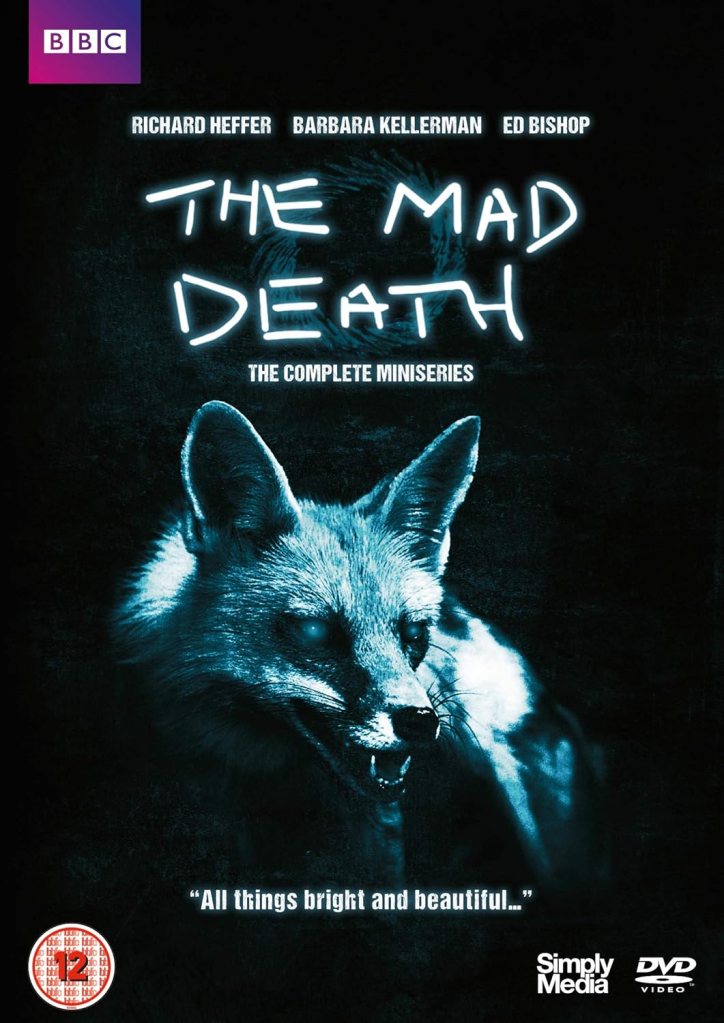
  • The Mad Death is a 1983 BBC drama, based on the novel of the same name, about the effects of a rabies outbreak in the U.K.

    Episode one sets the scene nicely, with a French woman successfully smuggling her cat into the U.K. Unbeknownst to her, her feline friend has already been infected with the killer disease. It soon gets loose, is run over and then feasted upon by a fox.

    Meanwhile, cheating ex-pat Tom Siegler – played by cult TV legend Ed Bishop – comes across said fox and, for reasons known only to him, decides to take it home.

    As you can imagine, this does not end well.

    Episode two concerns the public reaction to news of the outbreak and the decision to impound all dogs. The public do not take kindly to man’s best friend being locked up.

    Episode three turns into a bloodbath, with a decision taken to slaughter all animals to try and stem the outbreak.

    As someone who grew up in the ’70s and ’80s, the threat of rabies was everywhere, and this drama certainly taps into those fears. The scenes in episode one where Ed Bishop’s Siegler is ill in hospital are some of the most horrific moments I have ever seen in a TV series, and his eventual passing comes as a blessing.

    Yes, the series looks a bit dated but the story is strong, although by episode three it slightly fizzles out and dissolves into melodrama, thanks to the love triangle between Hilliard, Anne Maitland and her annoying husband.

    The acting is fine. Richard Heffer, familiar to cult TV fans for his role in 1970’s Survivors, is convincing as the heroic Hilliard, and Ed Bishop is memorable as the unfortunate Tom Siegler.

    The Mad Death is very much a product of its time. A time when our TV channels were full of Public Information Films warning us of the dangers of rabies (and quicksand, but that’s another story). And a time when TV channels would take a risk and make a drama which was slightly out of the ordinary.

    Sadly, I think those days of risk-taking are long gone.

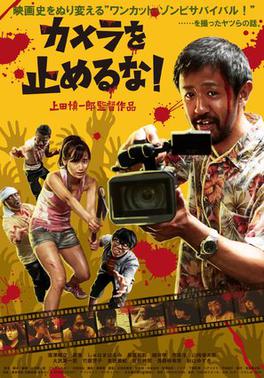
  • One Cut of the Dead is a 2017 Japanese horror comedy, written and directed by Shin’ichiro Ueda, and based on the stage play, “Ghost in the Box!” by Ryoichi Wada.

    The film is broken down into three distinct parts. In part one, we join a film crew on location at an abandoned water filtration plant, as they are making what is clearly a low-budget zombie flick. The film is overseen by Director Higurashi, who is becoming increasingly frustrated by his poor actors.

    During the shoot the cast and crew are attacked by real zombies, but Higurashi insists they carry on filming. (The Japanese title literally means, ‘Don’t Stop the Camera’)

    In the second part of the film we flash back to before the shoot began, where we learn more about the personal lives of the cast and crew.

    But is everything quite as it seems?

    Well of course it isn’t!

    I am not going to spoil part three, suffice to say it is quite hilarious and one of the most ingenious pieces of filmmaking I have ever seen.

    There are so many moments which pay off beautifully in the last act, and as soon as you finish watching it you will want to go back and see it again.

    The acting is wonderful right across the board, but special mention must go to Takayuki Hamatsu as the put-upon Director Higurashi.

    One Cut of the Dead is utterly hilarious and, weirdly, very uplifting, so if you haven’t seen it before, go watch immediately. And if you have seen it, well, you just know it’s about time you watched it again.

    Very bloody, very sweary and very, very funny, this is a film simply not to be missed.

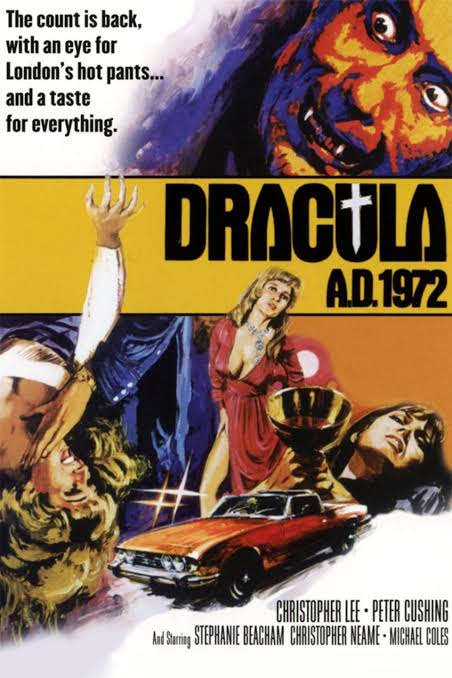
  • Dracula A.D. 1972 was the seventh Hammer film featuring Dracula and marks Christopher Lee’s sixth outing as the Count. We also have Peter Cushing returning as Van Helsing for the first time since 1960’s The Brides of Dracula.

    A prelude to the main story sees Dracula and Lawrence Van Helsing face off on top of a coach in London’s Hyde Park in 1872. Van Helsing successfully stakes the Count but is mortally wounded and dies shortly after. Fast-forward 100 years and we meet Lorrimer Van Helsing, expert in the occult, and his granddaughter, Jessica.

    Jessica hangs out with some very dubious people, none more so than Dracula groupie Johnny Alucard (it’s not subtle) who bears a striking resemblance to one of Dracula’s followers in the 1872 prelude.

    He decides to try and liven things up by performing a ritual to resurrect the long-dead Count and before anyone can say, ‘Dracula has risen from the grave’, Caroline Munro is sacrificed and all hell is literally let loose.

    To say this is a silly film is quite the understatement because it is utterly bonkers, however it is an absolute hoot from beginning to end.

    Acting wise, Peter Cushing is as believable as ever as the modern-day Van Helsing, whilst Christopher Lee, who has very little to do, looks utterly fed up.

    Christopher Neame, a familiar face on UK TV in the 1970s, appears terrifying as Alucard, however this illusion is shattered as soon as he speaks. Michael Coles is very good as Inspector Murray, who makes a welcome return in 1973’s The Satanic Rites of Dracula. I think I am correct in saying that he was the only person, apart from Cushing and Lee, to play the same character more than once in one of Hammer’s Dracula films.

    Incidentally, this film makes The Satanic Rites of Dracula look like a masterpiece.

    Go in with low expectations, a very stiff drink, and you should love it.

    And remember, “Dig the music, kids.”