They say the geek shall inherit the Earth. I’m counting on it.

  • The Omega Factor is a short-lived BBC drama which first appeared in 1979.

    Tom Crane is an investigative journalist who appears to possess untapped psychic powers. Whilst investigating the death of his wife, who perished in a mysterious car accident, he unwittingly becomes involved with Department 7, a secret government agency (aren’t they all), who investigate paranormal phenomena.

    Other members of Department 7 include the mysterious Martindale, who is supervisor of the unit. Should we trust him? Probably not. He is a complex character who leaves viewers uncertain as to his motives, and where his allegiance lies.

    Finally, we have Dr. Anne Reynolds, an old friend of Tom’s late wife, and someone whom he starts to fall in love with.

    I have to say, I was blown away by this series. I absolutely loved it. Like so many 1970s dramas, it is slow-moving and “talky”, but I really do not mind that. I believe it adds to the atmosphere.

    And speaking of atmosphere, the series was filmed on location in Edinburgh, which makes a nice change from London. The Edinburgh landscape plays a big part in the tone of the show. It has a grim, almost grubby look which I think heightens the bleak atmosphere.

    The casting is excellent. James Hazeldine – who passed away far too young – is wonderful as Tom Crane, and Louise Jameson, best known to cult TV fans from her stint in Dr. Who, is terrific as Anne Reynolds. Finally, John Carlisle is suitably untrustworthy as the morally ambiguous Martindale.

    With its themes of horror, sci-fi and conspiracy, with a touch of, ‘will they, won’t they’ thrown in, it is clear that the show is a very early forerunner to The X-Files, and it is a crying shame we only have one series of 10 episodes to enjoy.

    Mary Whitehouse, the famous ‘clean-up TV campaigner’, once described The Omega Factor as, “Thoroughly evil.”

    I think that is as good a recommendation as anything!
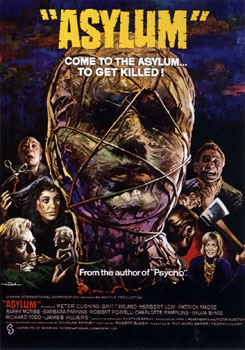
  • Asylum is a 1972 British anthology horror film made by Amicus Productions. The film is broken down into four short stories, along with a prologue and an epilogue.

    The prologue sees Robert Powell’s young Dr. Martin arrive to take up a post at the imposing asylum. He meets Warden Rutherford, who soon informs Martin that he believes the patients cannot be cured. Rutherford himself was attacked by a Dr. Starr, the former asylum head who is now a patient. The warden challenges Dr. Martin to prove his worth by interviewing the patients and deciding which one is actually Dr. Starr.

    We then go into the short stories where we find out about the patients and what brought them to the asylum in the first place.

    To be fair, the stories are bonkers, such as Richard Todd – playing against type as the womanising bad guy – being attacked and strangled by the severed arm of his wife, whom he has just dismembered.(are you following this?)

    It is even worse for his mistress, who ends up being menaced by the dead woman’s body parts, which are all neatly wrapped up in brown paper and string.

    I mean, you’ve got to be there, okay.

    Story two sees Bruno, a tailor, recount meeting the mysterious Mr. Smith (Peter Cushing, terrifying), who asks him to make a special suit which is created to the specifications of an ancient magical text, and has the power to bring the wearer back to life (a bit like shopping in Primark).

    Chaos ensues, which culminates in a mannequin coming to life, like something out of 1970s Dr. Who. It looks silly and it is silly but you just go with it.

    Story three sees the mentally unstable Barbara convicted of two murders which were committed by her friend, Lucy. But who exactly is the mysterious Lucy, and is she all she seems?

    Charlotte Rampling is very good as the confused Barbara.

    In the final story, Herbert Lom appears as Dr. Byron, a neurosurgeon with a collection of dolls which he believes he can make come to life.

    Let’s just say it does not end well, and Byron, angry that Dr. Martin does not believe him, exacts his revenge by bringing to life a miniature doll type robot thingy which goes on a murderous rampage.

    It is unbelievably stupid, but by this point I would have believed anything.

    The acting throughout is very good, with the likes of Peter Cushing, Richard Todd and Barry Morse all convincing. And Robert Powell is believable as the young Dr. Martin.

    It is all incredibly silly but I have always rather enjoyed an anthology film, and Amicus has come up trumps here.

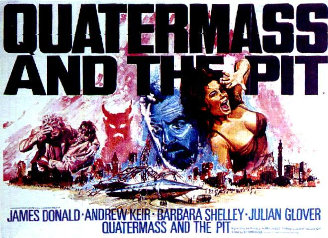
  • Quatermass and the Pit is a 1967 Hammer film which is based on the 1958 BBC drama of the same name.

    Written by Nigel Kneale, the plot revolves around building work taking place to extend part of the London Underground, and the discovery of what appears to be human remains. Nearby lies a metallic object which the military think is an unexploded bomb left over from the Blitz.

    But could it be something else?

    What then follows is a glorious mixture of ghosts, psychic ability and, most shockingly, Martian invasion, all tied up beautifully in Kneale’s evocative tale.

    Quatermass eventually surmises that humans are descended from Martians, which culminates in quite shocking scenes when Londoners go on the rampage, attacking those they perceive as being “different”.

    If this sounds like an allegory to racial tension then it is a correct assumption. Nigel Kneale admitted he was influenced by emerging racial tensions of the period, and the Notting Hill race riots in 1955.

    Once again, science-fiction is the perfect vehicle for holding up a mirror and reflecting society’s failings.

    The casting is uniformly excellent. Andrew Keir is wonderful as Quatermass, a great improvement, in my opinion, on Brian Donlevy, who I was never a massive fan of. James Donald and horror legend Barbara Shelley both provide excellent support, and Julian Glover is suitably boo hiss, as bad guy Colonel Breen.

    I bloody love this film so much. It is my favourite Hammer film and one of my all-time favourite films full stop. And I believe it cements Nigel Kneale’s reputation as one of the greatest writers of all time.