They say the geek shall inherit the Earth. I’m counting on it.

  • The Mad Death is a 1983 BBC drama, based on the novel of the same name, about the effects of a rabies outbreak in the U.K.

    Episode one sets the scene nicely, with a French woman successfully smuggling her cat into the U.K. Unbeknownst to her, her feline friend has already been infected with the killer disease. It soon gets loose, is run over and then feasted upon by a fox.

    Meanwhile, cheating ex-pat Tom Siegler – played by cult TV legend Ed Bishop – comes across said fox and, for reasons known only to him, decides to take it home.

    As you can imagine, this does not end well.

    Episode two concerns the public reaction to news of the outbreak and the decision to impound all dogs. The public do not take kindly to man’s best friend being locked up.

    Episode three turns into a bloodbath, with a decision taken to slaughter all animals to try and stem the outbreak.

    As someone who grew up in the ’70s and ’80s, the threat of rabies was everywhere, and this drama certainly taps into those fears. The scenes in episode one where Ed Bishop’s Siegler is ill in hospital are some of the most horrific moments I have ever seen in a TV series, and his eventual passing comes as a blessing.

    Yes, the series looks a bit dated but the story is strong, although by episode three it slightly fizzles out and dissolves into melodrama, thanks to the love triangle between Hilliard, Anne Maitland and her annoying husband.

    The acting is fine. Richard Heffer, familiar to cult TV fans for his role in 1970’s Survivors, is convincing as the heroic Hilliard, and Ed Bishop is memorable as the unfortunate Tom Siegler.

    The Mad Death is very much a product of its time. A time when our TV channels were full of Public Information Films warning us of the dangers of rabies (and quicksand, but that’s another story). And a time when TV channels would take a risk and make a drama which was slightly out of the ordinary.

    Sadly, I think those days of risk-taking are long gone.

  • One Cut of the Dead is a 2017 Japanese horror comedy, written and directed by Shin’ichiro Ueda, and based on the stage play, “Ghost in the Box!” by Ryoichi Wada.

    The film is broken down into three distinct parts. In part one, we join a film crew on location at an abandoned water filtration plant, as they are making what is clearly a low-budget zombie flick. The film is overseen by Director Higurashi, who is becoming increasingly frustrated by his poor actors.

    During the shoot the cast and crew are attacked by real zombies, but Higurashi insists they carry on filming. (The Japanese title literally means, ‘Don’t Stop the Camera’)

    In the second part of the film we flash back to before the shoot began, where we learn more about the personal lives of the cast and crew.

    But is everything quite as it seems?

    Well of course it isn’t!

    I am not going to spoil part three, suffice to say it is quite hilarious and one of the most ingenious pieces of filmmaking I have ever seen.

    There are so many moments which pay off beautifully in the last act, and as soon as you finish watching it you will want to go back and see it again.

    The acting is wonderful right across the board, but special mention must go to Takayuki Hamatsu as the put-upon Director Higurashi.

    One Cut of the Dead is utterly hilarious and, weirdly, very uplifting, so if you haven’t seen it before, go watch immediately. And if you have seen it, well, you just know it’s about time you watched it again.

    Very bloody, very sweary and very, very funny, this is a film simply not to be missed.

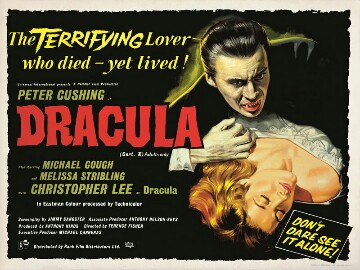
  • Dracula A.D. 1972 was the seventh Hammer film featuring Dracula and marks Christopher Lee’s sixth outing as the Count. We also have Peter Cushing returning as Van Helsing for the first time since 1960’s The Brides of Dracula.

    A prelude to the main story sees Dracula and Lawrence Van Helsing face off on top of a coach in London’s Hyde Park in 1872. Van Helsing successfully stakes the Count but is mortally wounded and dies shortly after. Fast-forward 100 years and we meet Lorrimer Van Helsing, expert in the occult, and his granddaughter, Jessica.

    Jessica hangs out with some very dubious people, none more so than Dracula groupie Johnny Alucard (it’s not subtle) who bears a striking resemblance to one of Dracula’s followers in the 1872 prelude.

    He decides to try and liven things up by performing a ritual to resurrect the long-dead Count and before anyone can say, ‘Dracula has risen from the grave’, Caroline Munro is sacrificed and all hell is literally let loose.

    To say this is a silly film is quite the understatement because it is utterly bonkers, however it is an absolute hoot from beginning to end.

    Acting wise, Peter Cushing is as believable as ever as the modern-day Van Helsing, whilst Christopher Lee, who has very little to do, looks utterly fed up.

    Christopher Neame, a familiar face on UK TV in the 1970s, appears terrifying as Alucard, however this illusion is shattered as soon as he speaks. Michael Coles is very good as Inspector Murray, who makes a welcome return in 1973’s The Satanic Rites of Dracula. I think I am correct in saying that he was the only person, apart from Cushing and Lee, to play the same character more than once in one of Hammer’s Dracula films.

    Incidentally, this film makes The Satanic Rites of Dracula look like a masterpiece.

    Go in with low expectations, a very stiff drink, and you should love it.

    And remember, “Dig the music, kids.”

  • Night of the Big Heat is a 1967 sci-fi horror film directed by Terence Fisher.

    The basic premise of the film is simple. A small island off the British coast is experiencing a mysterious heatwave, despite the fact that everywhere else it is wintertime.

    In the middle of this we find married couple Jeff and Frankie, (played by real-life couple Patrick Allen and Sarah Lawson). Jeff, an author, hires a secretary who just happens to be a woman he once had an affair with.

    So far so Love Island, but enter Christopher Lee, looking as furious as ever, as a mysterious scientist who spends his time setting up cameras and taking soil samples. Clearly he knows what is going on, but he is not telling.

    Suddenly, people start hearing a mysterious humming sound and end up dying in bizarre circumstances. The townsfolk, along with Peter Cushing in a cameo role (who, incidentally, never takes his jacket off, despite the 90 degree temperature), must band together to try and stop what we soon discover is an alien menace.

    The whole premise of ‘something mysterious running amok on a remote island’ is a familiar one. Indeed, Planet Films Productions’ earlier Island of Terror is very similar to this story.

    I think the problem with Night of the Big Heat lies in the love triangle between Jeff, Frankie, and Angela (who spends a lot of time in her bikini and rubbing ice cubes on her chest – I mean, whatever floats your boat, okay). It slows the story down and I cannot shake the feeling that the alien invasion is a minor inconvenience to Jeff, who would much rather be getting his leg over.

    Still, the cast is decent. Patrick Allen and his booming voice are very commanding, and Christopher Lee and Peter Cushing are as dependable as ever. The remainder of the cast is filled out with familiar British character actors, such as Percy Herbert, William Lucas and Kenneth Cope, and they all offer good support.

    As happens so often, the female characters are poorly served. They simply exist to look pretty, have men fall in love with them, and scream a lot.

    Different times, I guess, but very frustrating all the same.

    Night of the Big Heat isn’t one of the best, but it is perfectly fine and still worth 90 minutes of anyone’s time.

  • REC is a 2007 Spanish found-footage horror film, co-written and directed by Jaume Balaguero and Paco Plaza.

    The film follows reporter Angela, and her cameraman Pablo, who are covering the nightshift at a Spanish fire station as part of a TV series called, “While You’re Sleeping”.

    During the night, Angela and Pablo accompany the fire crew on a call to an apartment building, and very quickly it becomes evident that bigger forces are at work. Angela and Pablo end up trapped inside the building with the fire crew and some very frightened residents.

    And then it turns nasty, and I mean nasty.

    The very first time I watched REC, 15 minutes or so in I was convinced it was not my thing and I was going to hate it.

    How wrong I was!

    From the shocking moment Firefighter Alex is thrown over the staircase, the tension is cranked up until, by the end, it is almost unbearable to watch. The running time is only 78 minutes, so once it starts, it just does not let up.

    Also, the enclosed setting creates a wonderful feeling of paranoia and claustrophobia, which makes the film a nerve-shredding experience from start to finish.

    The acting here is perfectly fine. I think the nature of the film means that nobody really stands out, although, in saying that, the minor characters do make an impact, to the extent that we do care about them and we worry as to what is going to happen.

    I cannot really put into words how much I love this film. It is probably my favourite horror film of recent years, definitely the greatest ‘found-footage’ film, and one of the best horror films of all-time.

    If you haven’t yet seen REC then what on earth are you waiting for?

  • The Omega Factor is a short-lived BBC drama which first appeared in 1979.

    Tom Crane is an investigative journalist who appears to possess untapped psychic powers. Whilst investigating the death of his wife, who perished in a mysterious car accident, he unwittingly becomes involved with Department 7, a secret government agency (aren’t they all), who investigate paranormal phenomena.

    Other members of Department 7 include the mysterious Martindale, who is supervisor of the unit. Should we trust him? Probably not. He is a complex character who leaves viewers uncertain as to his motives, and where his allegiance lies.

    Finally, we have Dr. Anne Reynolds, an old friend of Tom’s late wife, and someone whom he starts to fall in love with.

    I have to say, I was blown away by this series. I absolutely loved it. Like so many 1970s dramas, it is slow-moving and “talky”, but I really do not mind that. I believe it adds to the atmosphere.

    And speaking of atmosphere, the series was filmed on location in Edinburgh, which makes a nice change from London. The Edinburgh landscape plays a big part in the tone of the show. It has a grim, almost grubby look which I think heightens the bleak atmosphere.

    The casting is excellent. James Hazeldine – who passed away far too young – is wonderful as Tom Crane, and Louise Jameson, best known to cult TV fans from her stint in Dr. Who, is terrific as Anne Reynolds. Finally, John Carlisle is suitably untrustworthy as the morally ambiguous Martindale.

    With its themes of horror, sci-fi and conspiracy, with a touch of, ‘will they, won’t they’ thrown in, it is clear that the show is a very early forerunner to The X-Files, and it is a crying shame we only have one series of 10 episodes to enjoy.

    Mary Whitehouse, the famous ‘clean-up TV campaigner’, once described The Omega Factor as, “Thoroughly evil.”

    I think that is as good a recommendation as anything!

  • Asylum is a 1972 British anthology horror film made by Amicus Productions. The film is broken down into four short stories, along with a prologue and an epilogue.

    The prologue sees Robert Powell’s young Dr. Martin arrive to take up a post at the imposing asylum. He meets Warden Rutherford, who soon informs Martin that he believes the patients cannot be cured. Rutherford himself was attacked by a Dr. Starr, the former asylum head who is now a patient. The warden challenges Dr. Martin to prove his worth by interviewing the patients and deciding which one is actually Dr. Starr.

    We then go into the short stories where we find out about the patients and what brought them to the asylum in the first place.

    To be fair, the stories are bonkers, such as Richard Todd – playing against type as the womanising bad guy – being attacked and strangled by the severed arm of his wife, whom he has just dismembered.(are you following this?)

    It is even worse for his mistress, who ends up being menaced by the dead woman’s body parts, which are all neatly wrapped up in brown paper and string.

    I mean, you’ve got to be there, okay.

    Story two sees Bruno, a tailor, recount meeting the mysterious Mr. Smith (Peter Cushing, terrifying), who asks him to make a special suit which is created to the specifications of an ancient magical text, and has the power to bring the wearer back to life (a bit like shopping in Primark).

    Chaos ensues, which culminates in a mannequin coming to life, like something out of 1970s Dr. Who. It looks silly and it is silly but you just go with it.

    Story three sees the mentally unstable Barbara convicted of two murders which were committed by her friend, Lucy. But who exactly is the mysterious Lucy, and is she all she seems?

    Charlotte Rampling is very good as the confused Barbara.

    In the final story, Herbert Lom appears as Dr. Byron, a neurosurgeon with a collection of dolls which he believes he can make come to life.

    Let’s just say it does not end well, and Byron, angry that Dr. Martin does not believe him, exacts his revenge by bringing to life a miniature doll type robot thingy which goes on a murderous rampage.

    It is unbelievably stupid, but by this point I would have believed anything.

    The acting throughout is very good, with the likes of Peter Cushing, Richard Todd and Barry Morse all convincing. And Robert Powell is believable as the young Dr. Martin.

    It is all incredibly silly but I have always rather enjoyed an anthology film, and Amicus has come up trumps here.

  • Quatermass and the Pit is a 1967 Hammer film which is based on the 1958 BBC drama of the same name.

    Written by Nigel Kneale, the plot revolves around building work taking place to extend part of the London Underground, and the discovery of what appears to be human remains. Nearby lies a metallic object which the military think is an unexploded bomb left over from the Blitz.

    But could it be something else?

    What then follows is a glorious mixture of ghosts, psychic ability and, most shockingly, Martian invasion, all tied up beautifully in Kneale’s evocative tale.

    Quatermass eventually surmises that humans are descended from Martians, which culminates in quite shocking scenes when Londoners go on the rampage, attacking those they perceive as being “different”.

    If this sounds like an allegory to racial tension then it is a correct assumption. Nigel Kneale admitted he was influenced by emerging racial tensions of the period, and the Notting Hill race riots in 1955.

    Once again, science-fiction is the perfect vehicle for holding up a mirror and reflecting society’s failings.

    The casting is uniformly excellent. Andrew Keir is wonderful as Quatermass, a great improvement, in my opinion, on Brian Donlevy, who I was never a massive fan of. James Donald and horror legend Barbara Shelley both provide excellent support, and Julian Glover is suitably boo hiss, as bad guy Colonel Breen.

    I bloody love this film so much. It is my favourite Hammer film and one of my all-time favourite films full stop. And I believe it cements Nigel Kneale’s reputation as one of the greatest writers of all time.